
Chicken Pirate Game: Pirate Battles and Bonus Hit Feature
Chicken Pirate by 100HP turns a pirate-ship duel into a step-by-step casino game. Your sword-wielding chicken faces a line of rival pirates, with every victory unlocking another multiplier. Four risk settings, a special Bonus Hit feature and the option to withdraw after successful battles give each round its own pace. Explore the Chicken Pirate demo or check where real-money play is available.
18+ only. Gambling carries financial risk. Demo access may require age verification.


Chicken Pirate Game Overview
Chicken Pirate casino game replaces spinning reels and road crossings with a sequence of one-on-one pirate battles. The interface shows the approaching enemies, current multiplier and a Withdraw button. Its distinctive features include four risk levels, Bonus Hit and a Provably Fair result-checking system.
Developer
100HP
Game Format
Battle / Instant Win
RTP
95%
Special Feature
Bonus Hit
Risk Settings
4 Levels
Cash Out
After Each Step
Betting Limits and Maximum Payout
The 100HP Chicken Pirate limits screen lists a minimum stake of 0.10, a maximum stake of 150 and a maximum payout of 10,000. These figures reflect the game interface, although actual betting limits may vary depending on the casino operator and account currency.
| Game Rule | Amount |
|---|---|
| Minimum Bet | $0.10 |
| Maximum Bet | $150 |
| Maximum Win | $10,000 |
The figures above are based on the game’s displayed limits. Available stake amounts, payout restrictions and supported currencies may differ between casino operators. Always check the applicable limits before playing for real money.
How the Pirate Battles Work
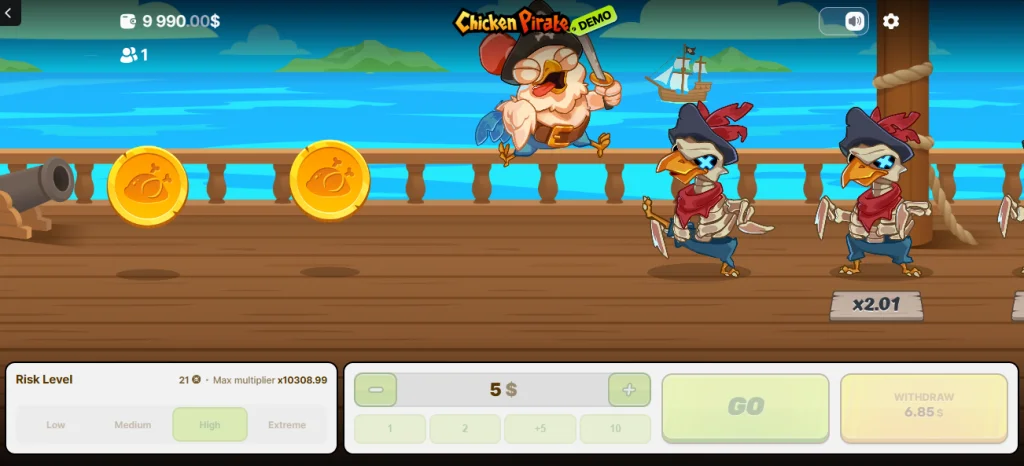
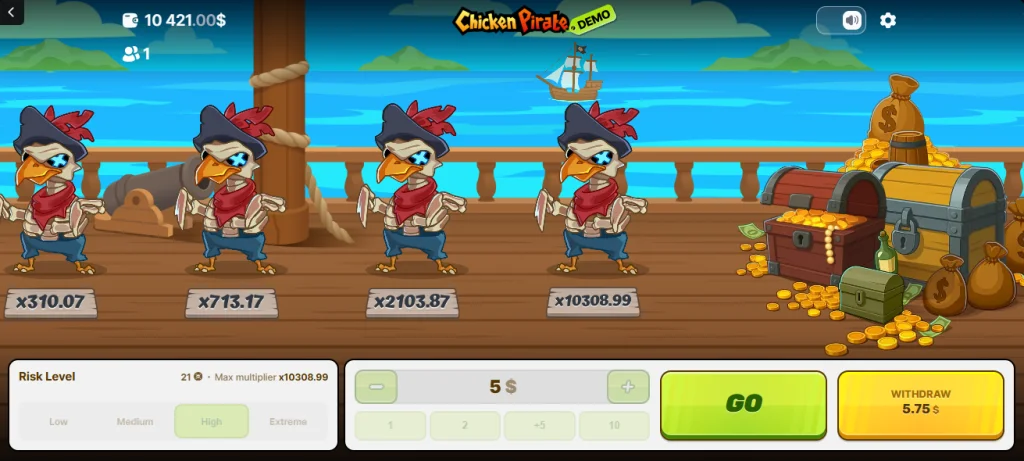
On the deck of a colourful pirate ship, a small captain with a cutlass confronts a row of skeletal pirate chickens. A cannon, sea horizon and treasure chest complete the scene. Unlike a conventional Chicken Pirate slot, the action unfolds as a succession of one-on-one encounters.
After each successful fight, the player faces a simple choice: keep the current reward or challenge another opponent. Winning moves the captain along the deck and raises the multiplier. Losing a duel ends the round and forfeits the active stake. Each duel is resolved by the game’s underlying system, so pressing Play faster will not improve your chances of defeating the next pirate.
Victory on the Deck
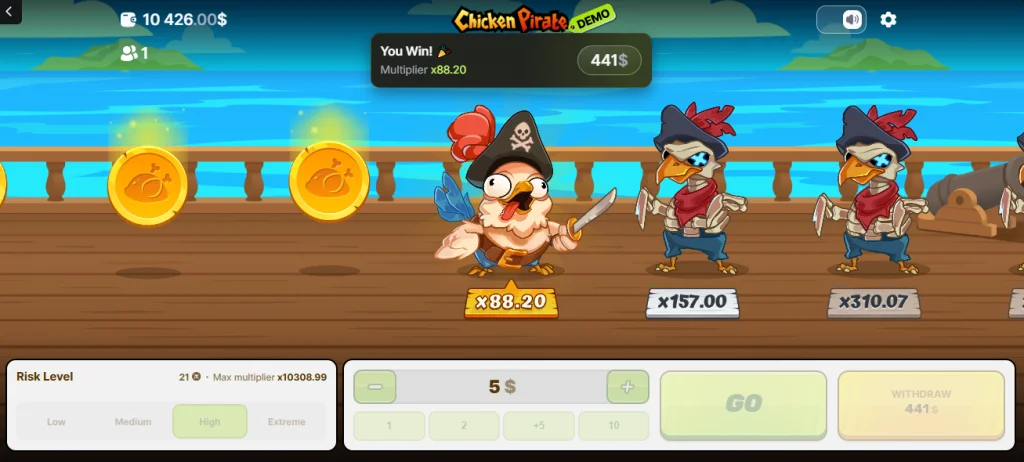
Defeating an enemy advances the pirate chicken to the next position and updates the available multiplier. You can then withdraw the displayed amount instead of entering another fight.
When the Captain Loses
An unsuccessful duel stops the voyage immediately. The multiplier accumulated on previous steps is not paid if you have not withdrawn before the defeat.
Withdraw or Face Another Pirate?
The Withdraw button becomes relevant after the captain wins a battle. For example, a $5 wager collected at 2.00x returns $10 in total, including the $5 stake. Continuing instead puts that wager at risk in the next duel. The treasure-chest theme does not change the payout calculation.
Choosing when to stop makes each round interactive, but successful battles do not make later enemies safer. The next outcome remains uncertain regardless of how many opponents have already been defeated.
Editorial note: The pirate animations illustrate results; they are not a timing challenge. Choosing when to withdraw manages exposure, but it does not change the predetermined outcome of an encounter.
Slot or Battle Game: What Is the Difference?
Chicken Pirate replaces traditional slot reels with a series of sword fights on a pirate ship. There are no paylines or free spins to follow. Although its step-by-step progression resembles a crossing game, the chicken must defeat rival pirates rather than navigate roads or obstacles.
How to Play Chicken Pirate: Five Steps
To begin, select a risk setting and stake. The game then presents a sequence of enemy encounters, with an opportunity to withdraw after successful steps. These are the main controls to understand before starting.
STEP 01
Explore the Demo
Open the free version to explore the ship, battle sequence and controls with simulated funds. Real-money access depends on the casino.
STEP 02
Choose a Stake
Enter a stake using the amount field or the /2 and x2 shortcuts. The selected amount is the wager you can lose in the round.
STEP 03
Select Your Risk Level
Select Low, Medium, High or Extreme. The higher settings offer greater potential multiplier growth but a higher chance of losing a battle.
STEP 04
Fight the Next Pirate
Press Play to send the captain against the next enemy. A successful attack moves the character forward; a defeat ends the round.
STEP 05
Withdraw or Continue
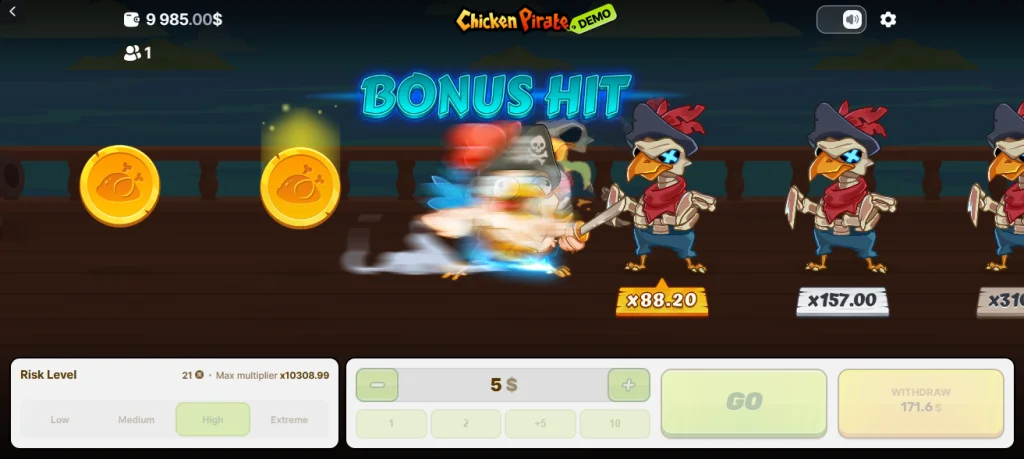
After a victory, use Withdraw to collect the current payout or continue fighting. Bonus Hit may sometimes advance the chicken through several steps automatically.
Practical tip: Try Chicken Pirate free play to learn where the risk selector, stake shortcuts and Withdraw control appear. A demo cannot reveal a reliable winning pattern.
Chicken Pirate Demo and Free Play
The Chicken Pirate game demo lets you explore the pirate-battle format without committing money. You can compare the four risk levels, watch multipliers update and observe how the Bonus Hit feature behaves when it occurs. Demo winnings are not cash prizes.
What to Explore in the Demo
- Four selectable risk levels
- Battle-by-battle multiplier changes
- Withdraw and stake shortcuts
- Bonus Hit and game-history panels
Free Play vs Real Money
In free play, stakes and payouts are simulated. Real-money sessions involve actual financial exposure and depend on a suitable licensed operator. Results in the two modes should never be treated as predictions of one another.
Launch the official 100HP demo to inspect the controls and Bonus Hit rules. Access or age checks may apply.
Chicken Pirate Bonus Hit: How It Works
The Chicken Pirate bonus feature is called Bonus Hit. Rather than awarding conventional free spins, it can send the captain through multiple positions after a successful battle. The feature follows specific conditions, so it is not available on every move and cannot be activated manually.
| Bonus Hit Rule | What It Means |
|---|---|
| Earliest activation | From step two |
| Final five steps | Bonus Hit cannot appear |
| Starting encounter | The chicken must defeat the enemy |
| Risk setting | Higher risk means a shorter bonus advance |
| Successful activation | The captain skips intermediate steps and collects multipliers along the way |
If the starting enemy wins, the stake is lost and Bonus Hit does not activate. The feature changes the pace of a successful round, not the need to manage risk. This is one of the clearest differences between this release and conventional crossing titles.
Four Risk Levels: Low to Extreme
Four settings are available: Low, Medium, High and Extreme. These are not four cosmetic themes: the game rules explain that higher risk means fewer opponents and a greater chance of defeat. Rather than inventing exact enemy counts, the comparison below focuses on how each setting changes the decisions players face.
| Mode | Battle structure | What to expect |
|---|---|---|
| Low | Longest progression of the four | Smaller multiplier increments and lower relative risk |
| Medium | Shorter sequence than Low | A more pronounced trade-off between payout growth and survival |
| High | Fewer encounters than Medium | Larger potential jumps, with more risk per encounter |
| Extreme | Shortest and riskiest sequence | The strongest emphasis on high multipliers and possible early loss |
On-screen example: The Low setting displays a maximum multiplier of x62.93 in the supplied screenshot. This is not a universal maximum across all four modes. Bonus Hit also becomes shorter as the selected risk increases.
The useful comparison is not which mode looks most rewarding, but how much of a stake you are prepared to expose to the next duel. A higher multiplier does not indicate that an opponent is more likely to be defeated.
Chicken Pirate RTP, Multipliers and Payouts
Chicken Pirate 100HP has a stated RTP of 95%, corresponding to a theoretical house edge of 5%. RTP describes an expected return over a very large number of wagers, not a percentage returned in an individual session. Individual sessions can produce wins and losses that differ substantially from this long-term figure.
| Game metric | Value | Explanation |
|---|---|---|
| Theoretical RTP | 95% | Long-term mathematical return, not a guaranteed result |
| House edge | 5% | Theoretical difference between total stakes and expected returns |
| Minimum stake | $0.10 | Amount shown in the supplied game limits, currency label adapted |
| Maximum stake | $150 | Upper stake limit shown in the game interface |
| Maximum payout | $10,000 | Cap on a collected payout |
| Multiplier example | x62.93 on Low | Displayed maximum for the Low setting in the screenshot |
The payout formula is straightforward: stake × collected multiplier = total return. A $5 stake withdrawn at x2.00 pays $10 in total, including the original $5. If the captain loses before withdrawal, the stake is forfeited. The $10,000 payout ceiling still applies when a calculated return would exceed it.
Provably Fair: The game provides a hash-and-Salt verification process for completed rounds. It helps players check recorded outcomes, but it does not remove the house edge or guarantee that the next battle will succeed.
Playing Chicken Pirate for real money requires checking the conditions offered by your casino. Available stakes, payout limits and supported currencies may differ from those displayed in the demo.
Managing Stakes and Withdrawal Decisions
No betting strategy can make a battle outcome predictable. Useful decisions instead concern how much to stake, which risk setting to use and when to stop a session. Bonus Hit is an automatic game feature, not a technique players can trigger on demand.
Limit Your Session Budget
Choose an affordable amount for the entire session before opening the game. A single unlucky duel can consume a wager immediately.
Avoid Chasing Losses
Use the stake shortcuts carefully. Doubling the bet after a defeat increases the amount at risk without improving the next result.
Set a Withdrawal Target
Decide in advance which multiplier would be sufficient for a withdrawal. Do not move the target simply because the pirate has won several battles.
Explore Risk Settings
Compare Low and Extreme in the demo to see how the sequence and multiplier display differ. The more aggressive mode is not inherently better value.
Stop at Your Limit
Set a time limit and a loss limit. If either is reached, close the game rather than chasing a treasure-chest payout.
Remember: Bonus Hit can accelerate progression but does not remove the possibility of losing the starting battle. It should not be treated as guaranteed profit.
What Works Well and What to Consider
The nautical setting, recognisable enemy encounters and Bonus Hit mechanic give this release a distinct identity. Its simple controls make the sequence easy to follow, while the 95% theoretical RTP makes the house edge relevant when comparing games.
Advantages
- Four risk settings to compare
- Distinctive pirate-ship visuals
- Bonus Hit can advance several steps
- Provably Fair result verification
- 95% RTP still implies a 5% house edge
Limitations
- Each failed battle loses the stake
- Bonus Hit is not guaranteed
- Real-money access depends on operator
Playing on Mobile and Desktop
The game runs in a browser-based interface with prominent Play and Withdraw controls. The layout is suited to a game catalogue linking to the online version, although performance and access can vary by device and operator.
Mobile Browser Play
On a phone, touch-friendly controls handle the stake, risk level and withdrawal decision. A stable connection is important during active rounds.
Desktop Experience
On a larger screen, the full deck, enemy sequence and betting panel are easier to view together. The Live, My and Top panels provide additional round and player statistics.
Chicken Pirate App Download: Is It Necessary?
No official Chicken Pirate app download has been verified. The linked browser demo does not require a game installation. Avoid unverified APK files or download pages.
For mobile access, prefer the verified browser version over unconfirmed installation offers. Availability for real-money play depends on local rules and the casino operator.
How Provably Fair Verification Works
The developer provides a Provably Fair verification feature. The rules say that step outcomes are set before the round and recorded through a hash, with Salt data available afterwards. Players can open a shield icon in their history to check a result. This is a transparency mechanism, not a guarantee of winning or proof that every casino hosting the game is licensed.
Operator check: Before placing a real-money bet, verify the casino’s authorisation, payment terms, identity requirements and responsible-gambling tools. The existence of a working demo is not itself evidence of operator reliability.
Frequently Asked Questions
Updated on: 16.11.2026